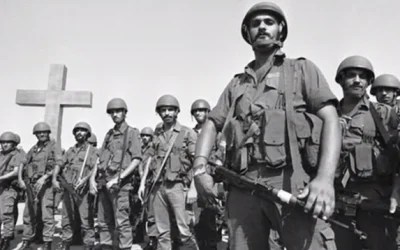
When we discuss Christian self-determination, if we answer the economic myth about the viability of such a project, objections move the goalpost to security: “But any Christian state will be immediately under attack from the majority Muslim neighborhood, and blood will be spilled”.
Detractors usually conclude with the idea that a Christian majority state will be overrun in a short period of time and can never know peace. This concern has some historical validation, given the violence that Christians were subject to during their long history in the region, but it’s also a tactic of fearmongering used by the majority to keep us in check.
Let’s point something obvious first: the argument that a Christian attempt at self-rule will ignite an existential war acknowledges the Islamic instinct to oppose any non-Islamic rule in the region, and it acknowledges that this instinct is fused violence. This permanent threat of violence is an old tactic that aims to keep all the minorities of the East in check. The first thing that a Christian self-determination movement must do is to break this political conditioning and expose it for what it is: this is not coexistence; it’s a hostage situation, where the other doesn’t attempt to kill us as long as we stay put and do as they say.
This validates our entire argument for the need to protect ourselves and ensure the future of Christians in the East through self-governance, but let us discuss the technical aspect of the objection, on the political and military scales.
The Geopolitical Environment of a Christian Canton
If we look at the current geopolitical reality, such fearmongering is not entirely true for several reasons. First, it’s disingenuous to propose that all Lebanese Muslims are out to get us; it’s simply not true. I’ll even go further and say that in the current circumstances, there’s a significant rising Muslim current – especially in the Sunni sect – pushing for federalism or even partition against the Hezbollah-controlled state.
Second, let’s assume for a moment that as Lebanon moves towards federalism or partition, Islamic movements and states (like Hezbollah or Syria) mobilize to quell the attempt by force. Even if that happens, the Christians will not be alone in this fight like they were in 1975, neither internally nor internationally.
Today’s politics are not the seventies of the Cold War. Christians are neither alone nor geographically sealed. The region has moved toward recognizing layered autonomies and minority self-administration. From the autonomous Kurdistan Region of Iraq to de facto arrangements in northern and southern Syria, international and regional actors are more practiced at treaty-based corridors, observer missions, and technical cooperation than they were in the 1980s.
The world today is not trying to solve the Palestinian cause by resettling an entire population in Lebanon, nor does it want to hand over the country to foreign armies like it did in the past century. The most significant foreign policy hazard we face today is the world growing tired of our bull**** and allowing regional projects, like the Wali Faqih, to run their course without international opposition.
It’s also unlikely that Sunni and Shiite factions will fight alongside each other today, and Christians may have stronger allies with the Druze and other minorities (if our leaders play their cards correctly).
A semi-independent state with Christian governance already existed for hundreds of years in the mountains, and this did not cause the mobilization of the Islamic world to destroy it. Second, Palestine is right next to us and has much more significance in the Islamic world, yet we don’t see global mobilization despite the elevated rhetoric.
The two real security risks to an independent mountain state come from inside Lebanon and Syria, but what’s important here is that these are political threats that can be navigated and made easier with a neutrality doctrine. There’s no insurmountable global jihadi army that some people imagine would show up instantly at our doorstep.
However, let us assume the absolute worst-case scenario, which any serious self-determination movement should do: let’s suppose that as the pieces move on the Levantine chessboard, we are completely on our own; what would happen to us then?
Defense-in-Depth of a Christian Canton
If the previous scenario happens, we’ll endure and survive as we did before, but this time supported by a vast, powerful diaspora that can see our situation in real-time. The Christian history in the Mountain is made of 1,500 years of defiant survival. It is not like the different empires that rose and fell in the region did not try to eradicate us already; it is just that they failed to do so.
Make no mistake, the Christians of Lebanon today are in a much worse shape than in 1975. They are unprepared, untrained, unwilling, and unequipped for any kind of internal clash, but if a clash happens, they’re not toothless – as shown by the events of Tayounneh in 2021. Such a clash might actually shock them into social cohesion and resistance. They have also have vast resources at their disposal, and tens of thousands of Army and security personnel and willing youth.
In general, if one thinks that the Christians of Lebanon can be defeated, then we’re dealing with the same type of delusion that believes Islamic nations could wipe Israel in minutes if they wanted to, despite history proving otherwise.
The Christian canton during the civil war from 1975 to 1990, with all its flaws, fragmentations, and the moral hazards of wartime patronage, survived multiple regional invasions and pressures. It did all that while it had a smaller militia, inferior material support, and less foreign backup than its enemies. It survived by exploiting defense-in-depth, local knowledge of terrain, logistical frugality, and social cohesion. That experiment only ended because of internal treason, which means that we have to learn from that and know that any modern defense doctrine of the Christian canton would involve stamping out any rival militias before they even start.
In our book, The Maronite Cause, we propose a full defense doctrine called “Whole-of-society-defense”, inspired by Finland’s defense doctrine, that considers all the strategic elements, and we will talk about it in detail in a future article.
What we can say now in short is that a small professional fighting force with guerrilla elements, along with a trained civilian corps of first responders, search and rescue, communication, and logistics, can hold ground in its core geographic areas almost indefinitely.
Finland, with a population and terrain comparable to the Mountain, maintains deterrence through universal conscription, citizen reserves, and hybrid tactics that blend conventional forces with guerrilla readiness and cyber defenses. This approach, rooted in “total defense,” leverages societal cohesion and landscape advantages without relying on patrons or overwhelming arms. For Lebanon’s Christians, adapting this doctrine means lawful civil-protection units, community training, and alliances with like-minded minorities, turning perceived smallness into asymmetric strength against local and regional threats.
Today we know that small communities can survive bigger security threats and larger armies with the right preparations and doctrines, even when they are outgunned, outnumbered, and alone. Add to it a mobilized diaspora and the geographical advantage of living in mountainous areas (which is still militarily significant even with all the technological progress), and you have all the modern conditions for endurance.
Add a diaspora factor that did not exist during previous conflicts: unlike the 1910s or 1980s, a million-plus capable professionals can be easily mobilized for the economy as well as in emergencies to contribute to the defense of their homeland. The diaspora can make an enormous difference for a Mountain state with seasonal service and professionalized settings, turning affection into capacity rather than clientelism.
None of this denies risk. Self-determination is only viable if it is competent and prepared: small constitutional core, municipal strength, sound defense doctrine, transparent budgets, credible courts, one lawful coercive chain, and an economy based on quality while training citizens as guardians and participators in their future.
A Secure and Viable Mountain
Let’s point out another obvious thing that’s rarely discussed when talking about security: objections to self-determination assume that confederalism or partition will happen under the current circumstances, but that’s far from realistic.
Any project of self-determination will take years of maturation and preparation, and part of that preparation is to make its future viable by strengthening local governance, defense abilities, and autonomy.
Economic and security concerns echo past fears but overlook modern tools: diversified trade, diaspora bridges, and sound defense doctrines that can render a mountain state agile and resilient.
Niche exports, micro-grids, a whole-of-society defense, and alliance pacts can hedge risks and turn smallness into strength. These aspects can be built over years and decades of preparation, but we must start today.
It’s imperative to mention that we also have allies in the region, in the Mediterranean and the world, who have been fighting similar battles and will stand with us, but we have to rely on ourselves and stand on our own feet first.
When the time comes to rule ourselves, we can secure our people and towns and cities block by block; and without the security burdens of the Republic and its endless pointless wars, we can also thrive.


Leave a Reply