This myth is based on a sliver of truth; it rests on facts that no honest Christian denies: Christians today are politically weak, organizationally fragmented, and demographically thinning, but does that mean that they cannot accomplish anything forever?
A Stark Reality
In the national arena, the Shiite bloc operates as a unified formation with an integrated party–militia structure and quasi-state institutions. The Druze act as a compact unified bargaining unit, and the Sunni field is fragmented but backed by regional vectors. In contrast, Christians are divided into multiple parties and rival leaderships with no unified vision and no coercive lever.
In cabinet arithmetic, in security appointments, in senior civil-service rotations, Christian influence has become transactional and symbolic rather than decisive. The presidency, once a stabilizing instrument, has been reduced to a bargaining chip traded among coalitions whose red lines lie outside Christian priorities.
Demography compounds the problem: below-replacement fertility rates, historical levels of skilled migration, and an aging base compress the horizon for collective action. This is the reality. We do better to admit it as it is.
From that reality comes the advice to “lower our sights” to decentralization or decorative federalism, but such a proposal misreads power and proposes a solution that does not solve the problem.
Resigning is not A Political Strategy
The truth is, decentralization or even nominal federalism is not really a solution to our unprecedented existential dilemmas.
In a system where one camp monopolizes veto by force, and others bargain through coherent blocks, decentralization is whatever the veto-bearing center allows today and can retract tomorrow.
Any centralized system, even if it was federal by name, that leaves coercion, external alignment, and key rents at the center will not shield Christians; it’ll be a trap. Under such partial solutions, Christians remain dispersed in a national game whose rules negate their leverage. Their densest assets, like territory, municipalities, schools, hospitals, and parish networks, are prevented from coalescing into governance capacity.
In a republic already operating as a market of forces, partial fixes do not compensate for fragmentation; they institutionalize it. They do not stop the decline; they just mask it.
Such defeatism does not take into consideration that Lebanese Christians still hold real comparative advantages that do not depend on national majorities.
A Strong and Undefeated Nation
Let’s spell a central truth: The Taif system, and most Lebanese powers, have waged a never-ending campaign of psychological (and sometimes actual) warfare against Christians since 1990. This campaign has resulted in the creation of dhimmi currents among our ranks, but also convinced most of our leaders and the young generation that we are powerless and unable to change our circumstances. This is our first and most dangerous defeat.
The reality is we are a strong nation with vast resources at our disposal and an even greater diaspora at our backs. We have a fighting spirit and a relationship with the land unmatched in all of the Levant; we come from families whose fathers and grandfathers were all warriors, stewards, farmers, monks, and incredibly resilient hard heads. We walk the same streets that saints and heroes walked on, and we carry their heritage and courage. Don’t let anyone tell you otherwise.
That said, here’s the concrete elements of power that we have:
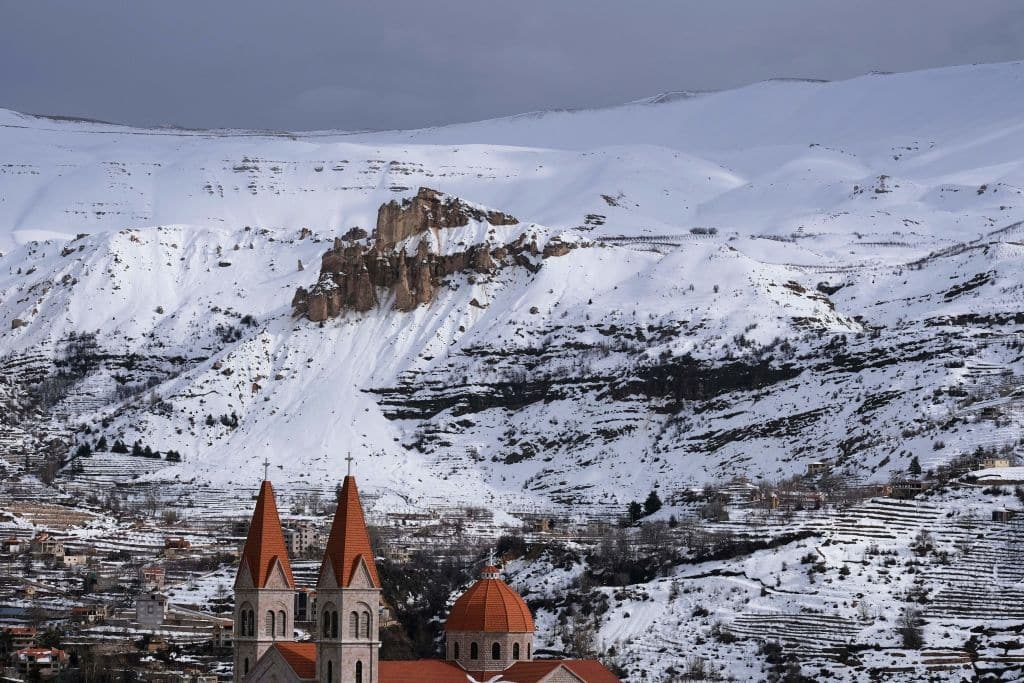
· Territorial coherence: Across Mount Lebanon (Keserwan–Ftouh, Jbeil, Metn heights, Bsharri–Zgharta–Batroun ridge, Jezzine, Zahle, parts of Chouf and Aley), Christians retain a concentrated presence where they are a majority, despite all the demographic pressure. In these areas, demography and land ownership patterns are favorable to continuity and effective governance.
· Institutional density: A disproportionate share of hospitals, universities, schools, and social NGOs are Christian-founded and run. These institutions pay staff, train cadres, and standardize behavior while national institutions wobble. These institutions are the foundation for any long-term bid for autonomy.
· Administrative muscle at the local level: Christian-led municipalities and municipal unions tend to manage their regions very well. They collect waste, keep streets lit, run registries, and broker local order more consistently than the center, because they are closer to taxpayers and reputationally exposed to their own voter base.
· The Christians are still a million strong: Despite all the demographic drain, we are still a vibrant and energetic community, with brains and muscle, with older thinkers and younger hotheads, with a significant wealth of material and human capital, with a higher than normal ratio of cadres and expertise, and a significant presence in the Armed forces in the tens of thousands.
· Diaspora power: The Christian diaspora is a vast network able to translate familial ties into economic and political power at scale. We’re talking about more than 10 million people with roots in the homeland. The diaspora has gotten bigger and stronger in the past decade and remains an unmatched switchboard for skills and credibility.
Set against rivals’ strengths, these are not romantic assets; they are governance assets.
The Shiite bloc’s advantage lies in coercive veto and regional depth. The Druze advantage lies in coherence and agility. The Sunni advantage lies in concentrated nodes and external support. The Christian advantage, at present, lies in territorial coherence, institutional density, local administrative competence, human and financial capital, and diaspora reach. These factors of power are underutilized and neutralized in today’s Republic.
Underutilized Power in a Rigged Game
The real issue is not that we don’t have power; we do. The problem is that the regime of the Republic is designed to neutralize our nodes of power and do the opposite for others.
Even in pure demographic terms, the Christians under the republic are intentionally kept as a minority through naturalization and social engineering. This won’t be the case if they had a decisive say in their affairs.
For example, the republic constantly puts roadblocks against the diaspora’s participation in national politics. It makes it extremely difficult for diaspora descendants to acquire citizenship, simply because Christians are the majority of our expat population. The Maronites alone are estimated to be between 4.2 and 12 million people around the world, with millions of descendants just in the Americas. The numbers become significantly higher if we include other Christian denominations.
Other points of pressure on Christians through the central state are the continuous attempts by the government to steal their lands. There are already dozens of municipal-level conflicts from south to north, in which sectarian parties like Hezbollah and Amal use all available means, including forged paperwork and intimidation, to take over lands that belong to the church or Christian individuals.
The government itself has tried twice so far to move the ownership of public land in Mount Lebanon governorate from municipalities to the state, first in 2015, then again in 2026, through a ministerial decree from the Ministry of Finance that’s led by an Amal minister. Such attempts would continue under decentralization or even weak federalism, but they would be extremely hard to implement under wide federalism, confederation, or partition.
The same rules apply at every level of the state: most Christians in government positions lack executive power, like the President, while others have it. We are not weak; we’re being neutralized by design.
Under today’s rules, Christian capacity is prevented from being converted into national leverage. The bid for self-determination changes that. Autonomous Christian governance, even if restricted by a wider federal arrangement, can convert these elements into leverage under a lawful jurisdiction because it allows dispersed strength to become a single operating system.
The national game is saturated without Christian influence: ministries are patronage silos for other sects, security portfolios are bargaining terrain for other sects also, and law is a procedure without teeth.
Under such circumstances, a fragmented Christian field cannot outbid better-armed or more coherent players on that board. Remaining there by default ensures the community continues to spend its dwindling capital defensively or to preserve symbols whose substance is already gone.
By contrast, consolidating into a coherent, governable space shifts the contest from arenas where Christians are permanently vetoed to arenas where they still possess decisive, non-substitutable inputs: land, schools, hospitals, municipalities, parish networks, SMEs, and diaspora circuits, mostly clustered in the Mountain.
The Time is for Work
“But you are too few.” Yes, Christians may be a minority in the Lebanese Republic right now, rendering them powerless on the national scale, but they are not few nor powerless in their mountains, where their institutions and voters are concentrated.
Politics does not run on the logic of numbers; it runs on the logic of capacity. A smaller, organized group can always outperform a larger, disorganized one, or it can make the cost of resistance too high even when it is up against larger foes.
The basis of autonomous governance is not numbers, either. Small nations endure when they run one lawful chain of coercion, guarantee equal rights, and make neighbors prefer predictable corridors to coercive experiments. Even today’s wars are not decided or fought with numbers.
“But you lack arms.” In the current republic, arms determine vetoes, not good governance. These vetoes are the very structure that dissolves Christian leverage in the Lebanese state. Proposing Christian self-governance does not mean the Christians have to arm themselves and face the other players in war. Autonomy, even if it is just a de-facto self-governance within the current republic, will render the arms of others useless in our areas.
No matter how strong Hezbollah or other militias are, they can subjugate or veto the center of the republic through their violence, but they cannot occupy and rule the mountain through their militia.
“But demography is against you.” Precisely. Under “business as usual,” the most capable of us are departing first. Staying in the republic will not solve the demographic bleed. In contrast, under a free Christian area that is measurably better governed, the flow slows or reverses. As we build stable institutions, staying here will become rational rather than suicidal.
You cannot win a demographic contest nationally, but we can win retention locally. A movement based on where Christians still align institutions, land, and authority can transform the mountain into a place where safety, life, and work become dependable and predictable. This would decisively change demographic dynamics.
“But foreign powers won’t accept it.” We will address international recognition in detail later, but for now, let us point out that today’s foreign powers already ignore Lebanon except as a risk. What they do not ignore is competence: they are even willing to negotiate with terrorist organizations if they have power and ability. So when we self-govern with hospitals that meet standards, schools that places graduates, utilities that work, and police that file and follow proper rules of engagement, they will engage with us sooner or later. A Christian bid for wide federalism or full independence that presents clean ledgers and enforceable guarantees is not a plea for love or charity; it is an offer of stability to actors who have lost patience with Beirut’s theater.
In the current balance, the world will not hand Christians leverage at the center, but it will contract with a Mountain that can be audited. If we build an effective, lawful nation, we will not be ignored.
Anything Less than Self-Determination is Unacceptable
We should recognize that the current Christian weakness stems from the rigged Republic and is not an inherent fate. Instead of staying captured in a decaying state, autonomy unlocks our potential and removes the pressure that this republic is exerting on our communities.
The argument that Christians are politically and demographically weak is accurate in the national frame, but self-governance in Mount Lebanon changes the board and reframes Christian presence.
Instead of playing a rigged game, it is time to make our own path. The Christians are not decision makers in the Republic anymore, but their strengths can be reorganized into a governable reality that can make our homeland a viable, livable, lawful place again.
 The Maronite Cause
Leave a comment