Why don’t you give the Lebanese Republic one more chance before demanding separation? Everyone in the self-determination camp receives this question at least once, but the answer is simple: how many missed opportunities do we need before realizing the folly of such a hope?
We don’t need to talk about ancient history or the Civil War, or the fact that the country has never been functional since its inception. Let’s talk about our own lifetime and the innumerable historical moments that the country wasted. Let this article be a history lesson and a reminder that we need to bury the hope of ever reforming this republic.
The Missed Opportunity of 2000
On 24 May 2000, Israel fully withdrew from South Lebanon in compliance with UNSC 425 (1978), with the Blue Line demarcated by the UN in verification. This should have been the big opening required to normalize the monopoly of force in the Lebanese Republic and start serious reform. Many back then saw it as an opportunity to integrate Hezbollah and its former “resistance” fighters into the national chain of command, and withdraw Syrian troops, who were still occupying the country and ruling it with an iron fist.
Instead, national elites avoided a doctrinal reset. They fabricated the Shebaa Farms issue, positing that Israel hasn’t fully withdrawn from Lebanese territory – and therefore nothing has changed. The “resistance” remained autonomous, now with upgraded prestige and more freedom of movement. Damascus’ grip remained in place, now ready to swallow the entire country without a regional check.
The precedent of armed exception that was supposed to be temporary under Israeli occupation became the new normal, and the country missed a historical chance at reform.
After the Israeli withdrawal and the reconciliation of the Mountain between Druze and Christians in the year 2000, the opposition to Syrian occupation kept growing. In 2005, it reached an inflection point: The assassination of Rafik Hariri mobilized mass protests and ignited the “Cedar Revolution”. It set in motion UNSCR 1559 core demands: foreign troop withdrawal and disarmament of militias. Under insurmountable local and international pressure, the Syrian army withdrew from Lebanon completely on 27 April 2005. The opportunity of the year 2000 was missed, but the Syrian withdrawal created a new opening.
The Missed Opportunity of 2005-2008
The international interest in Lebanon surged while the American administration under George W. Bush was reshaping the region from Afghanistan to Iraq. This manifested in a series of international resolutions supporting core Lebanese demands at the time: in addition to UNSCR 1559 (2003), there was also UNSCR 1636 (2005), which demanded Syrian cooperation with the international investigation into Hariri’s murder; UNSCR 1757 (2007) that created the Special Tribunal for Lebanon (STL), which later convicted Hezbollah members in absentia.
For Christians, 2005 briefly reopened their political space. Leader of the Free Patriotic Movement, Michel Aoun, returned from exile; Leader of the Lebanese Forces, Samir Geagea, was given amnesty and released from prison. The international atmosphere seemed to promise a return to a single sovereign state. But under the surface, the security regime did not change. The role of governance was handed over from the Assad regime to its allies inside, especially Nabih Berri and Hezbollah. The armed exception prepared itself to take over the country and proceeded to do exactly that, through a series of targeted assassinations and political violence that lasted more than a decade.
As the state was trying to rearrange itself around the new March 14 alliance, and as Christians of Lebanon were now reorganizing and preparing to re-enter public life and play a decisive role in politics, Hezbollah’s military adventures in the south triggered a 33-day war with Israel in July 2006.
In addition to the human cost, the conflict caused a huge financial setback for Lebanon, with an official estimate of growth declining from 6 to 2%, in addition to 5 billion USD in losses (22% of GDP). The war ended with UNSC 1701 in August. The new resolution called for cessation of hostilities, Israeli withdrawal, the deployment of the Lebanese Army and UNIFIL south of the Litani, and the disarmament of Hezbollah.
The moment the war stopped, however, Hezbollah started rearming, rendering the 1701 useless. The war gave renewed international and local legitimacy to the Shiite party, making it appear as a parallel deterrence force more capable than the state. The party started presenting itself as a higher political entity with a role above Lebanese politics, justifying keeping itself armed indefinitely. The 2006 war also marked a strategic shift in the party that started demanding special privileges in the Lebanese political system.
A Hezbollah Republic
After 2006, Hezbollah became more involved in internal politics. It mutated further into a parallel state with its own army, banks, policing, education institutions, media channels, and social services. This expansion clashed with and corroded the state significantly, compromising judicial independence, security, and the very fabric of Lebanese society.
Immediately after the ceasefire, Hezbollah moved to paralyze the 14 March government. It staged a sitting protest in Downtown Beirut, shutting down the Capital and crippling the entire country for two years. This coalition did not have a parliamentary majority at the time, but was emboldened by its new alliance with Michel Aoun, who pivoted from the March 14 alliance and gave the Shiite party an overwhelming Christian legitimacy.
As fears grew from the possibility of Hezbollah using its arms to break the political gridlock, its leader Hassan Nasrallah vowed publicly on television that his party would never use violence to impose its political will. A promise he broke soon after, as his political protests failed to achieve their goal.
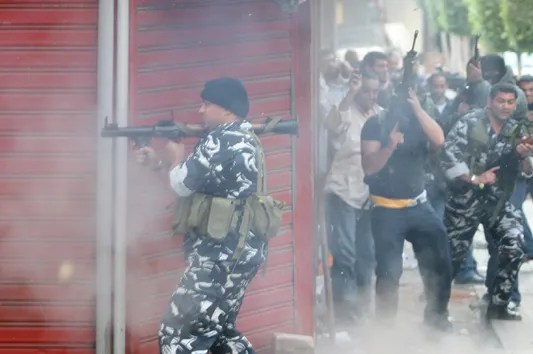
Under the pretext of a government decision to remove an illegal Hezbollah communications network in the airport, Nasrallah and his allies used their sectarian army to invade the Capital and other Lebanese areas on 8 May 2008. The clash caused the death of more than a hundred civilians and forced the signing of the Doha Agreement on 21 May 2008. Through this new accord, Hezbollah officially acquired a veto power inside the government and ensured they rule the country unchallenged.
Since then, Hezbollah used a mix of political tactics to rule the country without governing it: imposing an election law that guarantees Shiite majority rule in the parliament, using one-third veto extensively inside the cabinet to obstruct unfavorable policies, using the signature of the Shiite Finance Minister to block or facilitate certain policies, the closing and opening of the Parliament at will through its Shiite President to control the legislative agenda and political pace. It also imposed constitutional and administrative voids to advance their agenda, including at the presidency, prime minister position, and first-grade administrative positions, withholding qorum or using their veto to ensure the appointment of their own loyalists at all levels of the state.
When constitutional methods were not enough, Hezbollah resorted to intimidation (for example they bombed a bank headquarter that was implementing an internationally required anti-laundering bill), assassinations (35+ targeted assassinations between 2003 and 2021), street violence (The Black Shirts incident in 2011 that removed Saad Al Harriri from Premiership and imposed Najib Miqati as MP), and Tayyouneh incident in 2021 (to obstruct the investigations in Beirut Port Blast).
For Christian communities, the signal from the Doha accord in 2008 was devastating: veto power existed outside the presidency and outside formal institutions. It was held by the actor who was also armed, giving the Shiite sect an unprecedented level of power that no other sect in the history of the First Republic ever had.
For the next 18 years that followed, the Republic tilted progressively in favor of one sect and one political party while everyone else became second-class citizens. Christians became unable to even elect a president or even appoint a first-grade manager in administration without Hezbollah’s approval. Many positions were progressively switched from Christian and Druze positions into Shiite, including sensitive positions in the Army and Security Forces, with a prime example being the Head of General Security (Border Control) being switched from Maronite to Shiite. The country proceeded to have no president and no cabinet for years on end, leading Christian politics into reactive fear of losing their constitutional positions and accepting whatever candidates imposed by Hezbollah.
Through their control of ministries, the port, airport, and all security positions, Hezbollah ensured that the state serves one party and one sect above all others. Even the law itself came to be selectively applied to all other sects except the Shiia.
The opportunity created by the blood and sweat of fifty years of struggle for sovereignty and independence was lost as the state surrendered control to the mullahs, and the country plunged into two decades of Hassan Nasrallah ruling it from the shadows.
The Missed Opportunity of 2025: Fool Me Thrice
The events unfolding from 2025 onwards are almost an identical repeat of what Hezbollah did after the year 2000 and 2006. In 2025, after a devastating war, many people had hope that a new president, prime minister, and a cabinet without the blocking third of Hezbollah for the first time in 17 years, would move the country forward. But in 15 months, even with unprecedented local and international support, the government only acted as a front for Hezbollah, doing its bidding, buying time, acting dumb, and enabling it to rearm itself and control the government from the shadows. Hezbollah, in a way, fooled us for the third time, but we’ve got only ourselves to blame now. It’s not that Hezbollah is smart; it’s that our leaders are either dumb, weak, or compromised.
Some would say that Hezbollah has been weakened significantly and that the Trump administration is more serious, which creates another opportunity. They say, “this time is different, I promise”. It is indeed different, but for the worse. The problem is that in 2000 and 2006, Hezbollah did not have the entire Republic under its thumb like it does today.
We currently don’t have a Pierre Gemayel, a Ghassan Tuweini, or an entire March 14 cross-sectarian Alliance that can speak truth to power and provide internal legitimacy. Instead, we have Abou Falafel for a President, Mr Word Play as Prime Minister, and a bench of weak Christian parties still afraid of hurting Hezbollah’s feelings. On top of all that, we have Hezbollah members and loyalists at every level of administration in the Government, Army, and Security apparatus.
All the Lebanese factions have already tried the road of inviting Hezbollah back to the state, but Hezbollah is the state. It’s kind of ridiculous, even comical, to invite them to trick us one more time. We’re hoping that the state, which is Hezbollah, would rid us of Hezbollah by inviting Hezbollah back to the state. How do we even describe such a level of incompetence by Lebanese politicians?
All that and we haven’t even touched yet on the fact that the different communities that make up Lebanon can never make an effective state through consensus, even without the existence of something like Hezbollah. Moreso, Hezbollah’s problem is not its arms, but its very nature is incompatible with the rest of Lebanon; keeping it as a decisive political force in the central state doesn’t make anything better.
We’ve been through this road before, in 1943, in 1958, in 1969, in 1975-1990, in 2000 and 2006, and finally in 2025 and 2026. This time, it’s not that Hezbollah is fooling us; it’s us fooling ourselves. Enough is enough.
_________________
This article is an excerpt from Chapter 6 of The Maronite Cause book Volume I. Our books are available on these links:
The Maronite Cause Volume II: Self-Determination and the Path to a Mountain State – Free PDF edition
The Maronite Cause Volume I : History, Collapse, and The Case for Survival – Free PDF edition
Physical and Kindle versions can be ordered via Amazon:


Leave a Reply