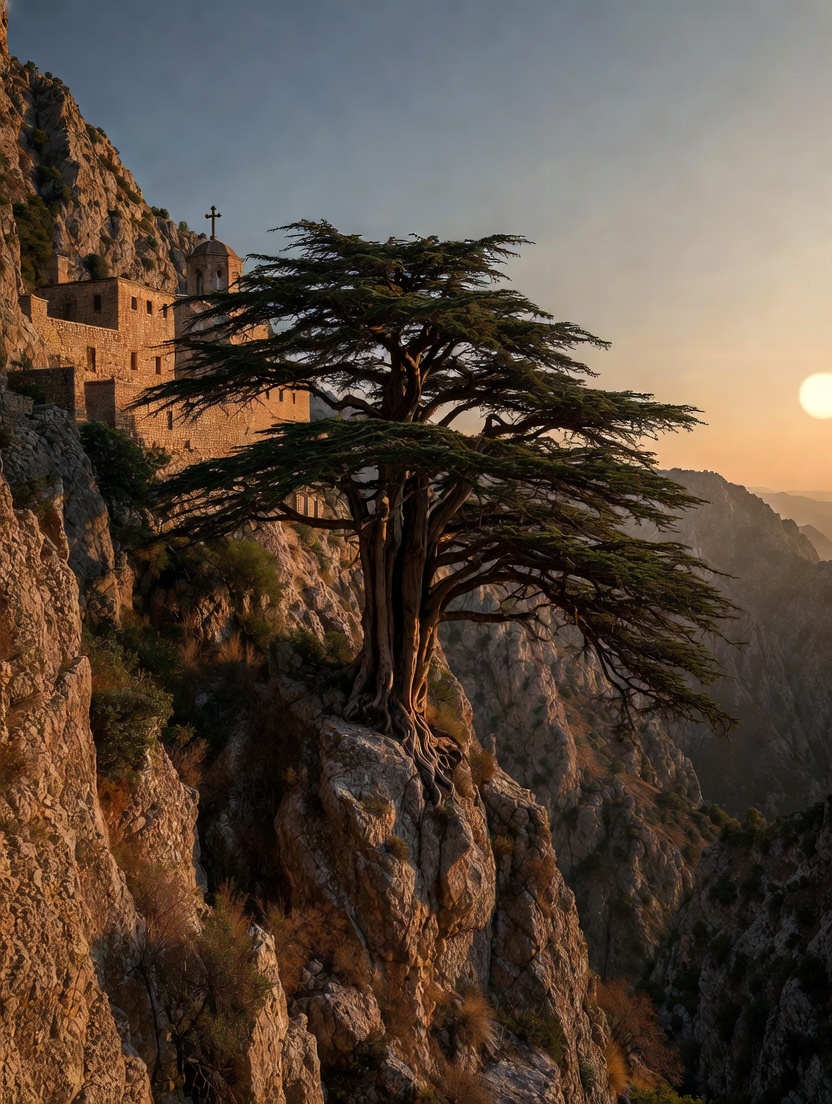
On the day of the feast of St. John Maron, we remember our spirit today. Almost 1400 years have passed since his time. As we are faced with existential threats from every side, every Maronite now asks a heavy question: why fight for our identity and homeland when we can simply leave or accept a slow drift into oblivion?
Bearing the Cross of the East
We choose to persist in Mount Lebanon for countless reasons.
We stay because there are places in the world that ask something exacting of the human being and, by asking, make us more than we are.
Transcendence and meaning are rarely found where the slope is easy. If fate has decided that this is how we overcome ourselves, that this is how we carry our cross and find our place in Heavens, then amor fati (we love our fate).
Not all of us accept the calling; we are just human after all. Most of us want normal, comfortable lives. Why accept it and choose to stay when we can simply leave? Why fight when we can drift into a pleasant sleep and let our nation fade into eternal silence?
Because we simply want to live as who we are, and we want to be who we have become after thousands of years of trials and love.
We want to see how far we can transcend and how high we can rise in the face of the most challenging human experience the world can give.
A people who have learned to build terraces out of cliffs and bread out of stone know that dignity is not delivered by fortune but crafted by fidelity.
We stay because the mountain, with its short seasons and long memory, is a beautiful place.
We stay because this tired region of the world is a school for souls: it nurtures resilience and reliability, punishes shortcuts, rewards steady hands, and returns whatever we bring to it, care or neglect, with interest.
We stay because the world and the region need our community and the brightness of our individuals. Because the world needs custodians of difficult places who can show that freedom is possible in a place without abundance, that civility can be practiced without softness, that community and meaning can be chosen in a century that teaches us to drift into the devouring voids of nihilism.
We stay because the young must learn that identity is not a playlist but a craft. That home isn’t a summer vacation but a living place. That belonging is not a sentiment but a discipline.
We stay because we know that the most reliable way to become larger on the inside is to attach oneself to something bigger than our personal worries and goals: to a work that will outlive us, to springs and forests and places that will provide goodness, joy, and shade for countless generations after us.
We stay because the mountain trains the reflexes we most admire in others: discipline of will, generosity without exhibition, and the courage to hold our ground without hating our neighbor. We stay because we would rather be formed by a terrain that speaks honestly than soothed by a comfort that slowly unties us.
We stay because each departure subtracts a voice from the choir and a pair of hands from the harvest. Because there is a threshold beyond which even the most beautiful liturgy sounds like an echo of what might have been.
We stay because our elders did not keep our nation alive through countless baptisms and marriages and wars across generations, so that their grandchildren could become a memory. We stay because they taught us to do the right thing when they lifted walls with their bare hands, when they sang in a language older than their sorrows, and when they trusted us to decide that continuity is a form of courage.
We stay because the task ahead of making a small, lawful, free country in the hardest neighborhood on earth, no matter how difficult, is the sort of task that builds not only roads and courts, but souls.
We stay because we do not accept a slow drift into irrelevance, and we do not mistake safety for life. Life for us has never been an arrangement of convenience, but a posture toward Truth.
We stay because our neighbors, even those who do not share our creed, need a companion who believes in freedom and decency. We stay because the very act of building a lawful state where we govern ourselves and decide our destiny gives our children a vocabulary for adulthood that no passport stamp can supply.
We stay because the mountain teaches transcendence that is not escape: when you climb, you breathe harder, but you see farther.
We stay because the work of turning fear into order and scarcity into cooperation is a human art worth mastering, and because it is a joy to watch our villages and valleys become alive, as we choose to remain.
We do not preach survival as an idol, but we understand that a steadfast, merciful people in this place can keep a light that others in the East still need. We understand that our fidelity to the mountain becomes, without slogans, a testimony to the One who entered a small land and made ordinary life holy.
We stay, finally, because staying is how love becomes eternal: the love of parents for children not yet born, of the living for their ancestors, of citizens for a nation that must be earned to be kept.
To stay is to say: we will overcome because we are willing to be shaped by the Mountain; we will transcend because we accept the limits of our humanity; we will grow because we choose to walk on the hard, rugged edge of this place; and we will be a community because we keep each other honest.
We stay because we have all the tools that enable us to survive and thrive in this Mountain. Because our spirit is itself our practical blueprint for a thriving future.
We can keep listing reasons, but at the edge of every secular cause stands the first principle that taught us to measure our days in good actions: because we were asked to witness his love and glory in this area of the world. Because we bear the Cross of the East by choice and by grace.
A Choice to Be Made
Each of us must make our choice. And in that choice, in that daily modest heroism of every Maronite man, woman, and child, the Maronite spirit will again find its vocation: a warrior in restraint, a steward on their land, a monk in mercy; a people at home… and a lamp that shines forever.
 The Maronite Cause
Leave a comment